
Amphibians are animals that can live both in water and on land. They usually start their lives in water as eggs, and hatch there as babies (like tadpoles), before growing up to live in both water and land environments.
Amphibians have smooth, wet skin, through which they can breathe (although most also have lungs as well). Tadpoles start off breathing through gills (like fish) and only develop lungs as they grow older and start to turn into frogs. Like reptiles, amphibians are cold-blooded vertebrates.
Frogs are amphibians. Many species of frog can be found in the Daintree. There are 54 native frog species that live there, including tree frogs.
The Australian Green Tree Frog
Our Favourite Daintree Amphibian
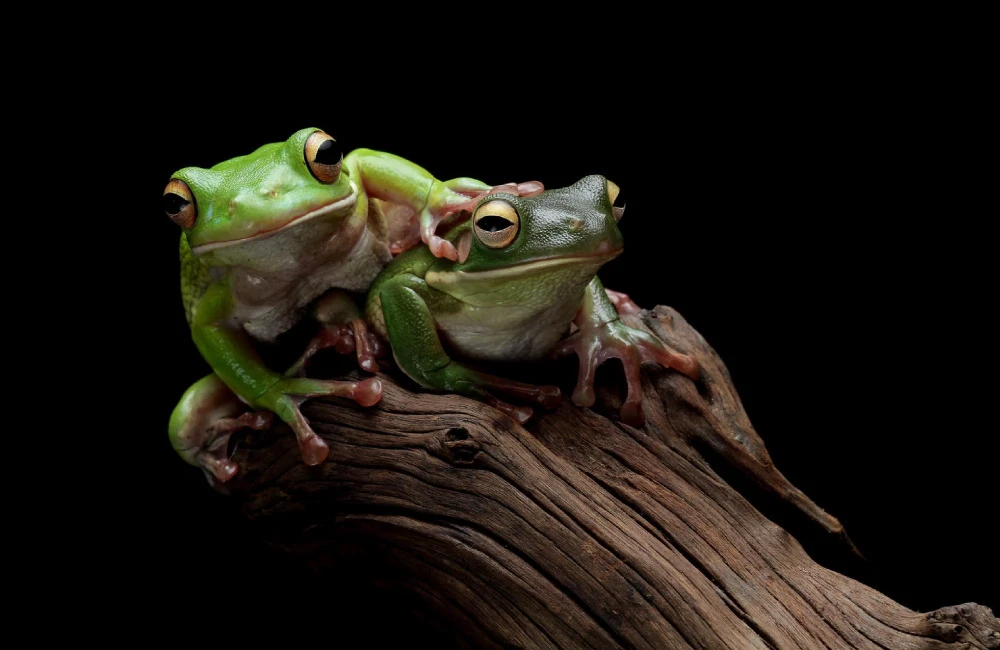
- Australia is home to the green tree frog, one of the happiest-looking frogs in the world! It looks as if it is smiling.
- The brightly coloured green tree frog is not hard to spot! Check out its beautiful golden eyes and cool fingers and toes above.
- The green tree frog is mostly nocturnal (which means its active at night and sleeps in the day). During the day, the frog hides in plants, tree hollows and rock crevices. At night, it comes out to feed.
- Nighttime snacks include spiders, insects and sometimes even lizards and snakes. Small snacks like insects are caught on the frog’s sticky tongue. The green tree frog catches larger animals in its mouth and then stuffs them down with its hand – pretty greedy!
- Green tree frogs ‘drink’ water through their skin, they don’t drink water through their mouth. They need to find water sources to keep their skin wet. Some green tree frogs are even known to visit the toilet bowl!
- They can lay between 1000 and 2000 eggs per year.
- Green tree frogs are not just found in the Daintree. They are found throughout eastern and northern Australia, including Queensland, New South Wales, the Northern Territory, and northern parts of Western Australia.
- Although most green tree frogs are, unsurprisingly, green, there have been sightings of blue tree frogs of this species. Scientists think that these particular frogs have no yellow colour genes, allowing the main colour to show as blue (if you mix blue and yellow you get green).
Learn More
Read more about the ‘blue frog’ on the Australian Museum website: https://australian.museum/blog-archive/explore/whites-true-blue-green-tree-frog/
The story of Rana the Tree Frog was inspired by unique creatures and the explorers who discover them – reminding us that protecting animals starts with careful observation, and that human actions need to be thoughtful to avoid harming their homes.